Property Market Update - September

Charlie Panayi • October 3, 2024

Summary

  Lowest mortgage rates for 15 months

• Buyer demand and sales agreed up by over a quarter since 2023

• UK house prices up 0.7%, from -0.3% a year ago

• House prices are rising by up to 2.5% in more affordable areas

• Almost a third of homes for sale are ‘chain-free’ as investors and second home owners sell in face of recent and possible tax changes

• Some coastal and rural areas see supply of homes for sale up 40% on last year


The UK property market has continued to recover steadily through September, with house prices increasing slightly by 0.7% over the past year. This shift is subtle but marks a notable improvement from the -0.3% drop experienced a year ago. The rebalancing is largely supported by falling mortgage rates and an increased number of homes coming onto the market, particularly chain-free properties. While prices are climbing, buyer caution is still evident as affordability remains a key challenge in certain regions. As long as properties are priced correctly, they are moving!


Buyer Demand Rising

Buyer demand has surged by 26% compared to this time last year. Lower mortgage rates are the main driver of this renewed activity. The average rate for a 5-year fixed mortgage at 75% LTV now sits at 4.3%, a significant drop from 5.5% a year ago. With more favorable financing options, households who had previously held off are re-entering the market. Sales agreed are up 25%, showing buyers are ready to move when the price is right. However, the market remains price-sensitive, with many buyers securing deals below asking prices.


Mortgage Rate Impact

The drop in mortgage rates is a welcome relief for many, providing a much-needed boost in affordability. The competition among lenders is particularly beneficial for buyers with larger deposits. The market has now seen the lowest mortgage rates in 15 months, and this is expected to stabilise around the current levels, with rates hovering in the mid-3% to low-4% range through early 2025. This continues to encourage prospective buyers, though affordability constraints remain particularly acute in the South.


Supply and Chain-Free Properties

One of the defining features of the current market is the influx of chain-free properties. Nearly 32% of homes for sale are now chain-free, driven largely by investor and second-home sales as owners react to anticipated tax changes. Coastal and rural areas, such as Bournemouth and Torquay, have seen a 40% rise in supply as these properties hit the market. Additionally, more homes listed for sale had previously been rented out, with landlords particularly concentrated in London and the South East selling off due to higher borrowing costs and low rental yields.


Regional Price Variations

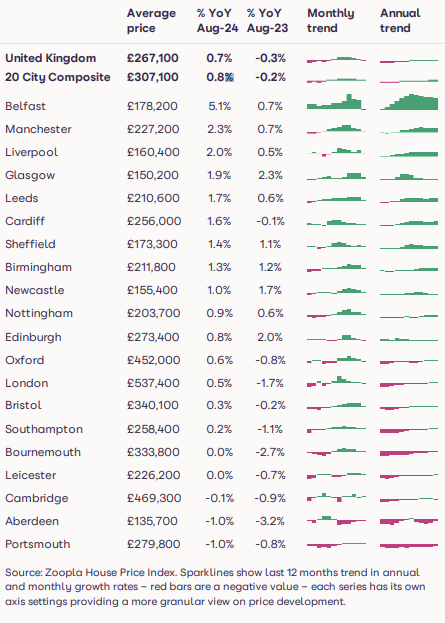
There are stark contrasts in price performance across the UK. Northern Ireland leads the way with house prices up by 5.7% year-on-year, while cities like Manchester and Liverpool have also seen solid growth at 2.3% and 2.0%, respectively. However, southern regions such as the South West and South East remain under pressure, with price declines persisting in some areas. London, after seeing a 1.7% drop last year, has rebounded slightly with a 0.5% rise, though affordability continues to be an issue for many first-time buyers in the capital.


Outlook

Looking ahead, the market is expected to maintain its current trajectory of modest price growth, particularly in more affordable regions. While the broader economic outlook remains uncertain, a combination of stable mortgage rates and a higher level of household incomes should help sustain the market into 2025. Sellers, however, must stay realistic with their pricing, as buyers continue to prioritise affordability and value for money. Price-sensitive buyers, combined with a growing number of homes on the market, will keep house price inflation in check for the foreseeable future.


Check out the latest city performance through the UK:
Want to talk UK property, investment or how to start? Drop me an email to talk further


Information gathered from personal knowledge of market, rightmove, zoopla and hometrack.
By Charlie Panayi November 27, 2025
(aka: I tried not to rant… but here we are) Ok… I’ve taken the night so I don’t rant too much, but honestly? This Budget has left me scratching my head. I genuinely cannot understand the logic of it, and yet, with this government… I can. What we saw this week doesn’t support growth, it doesn’t encourage work and it definitely does not reward the people who actually build this country. Instead, it does the one thing you should never do in a fragile economy... It stifles ambition, punishes entrepreneurship and discourages anyone trying to get ahead. An d that’s the part that gets me, who is thinking this stuff up? With what logic? In what universe does any of this equal “growth”? Let’s break down exactly what they’ve done, in plain English with actual specifics... and by the way I give an optimistic view at the bottom... YES Fiscal Drag on Steroids (and nobody voted for this) The government has frozen tax thresholds for years into the future. What does that mean in real life? You get a small pay rise Or your business earns a bit more Or inflation pushes wages up (as it always does) A nd suddenly, you’re in a higher tax band. It’s a tax rise without them admitting it’s a tax rise...A stealth tax. Quiet. Sneaky. Effective. This affects: workers business owners company directors self-employed people Basically, anyone who earns anything from honest effort. And let’s be clear, this doesn’t hit “the rich.” This affects normal people . Attacks on Investment & Property (aka: why build anything here?) The Budget introduces: Dividend tax is rising by +2 percentage points From the next tax year: Basic rate dividend tax: 8.75% → 10.75% Higher rate dividend tax: 33.75% → 35.75% Additional rate dividend tax: 39.35% → approx. 41.35% So if you take money from your own company? You now pay more tax for doing so. Rental income & savings income tax is also rising by +2 percentage points Basic rate: 20% → 22% Higher rate: 40% → 42% Additional rate: 45% → 47% If you’re a landlord or you receive any savings interest? You now get taxed more, instantly reducing margins and profitability. A brand-new “mansion tax” on homes over £2m This starts in April 2028 : Properties £2m–£2.5m → £2,500/year surcharge Properties up to £5m+ → up to £7,500/year This is on top of normal council tax. Not instead of. On top of. The message is loud and clear: “Don’t bother investing here. Build your future somewhere else.” It’s unbelievable, if you want people to invest in housing, in businesses, in long-term growth...you don’t do this. Crushing small businesses and directors SMEs make up 99% of UK businesses. They employ the majority of the private sector. They are the backbone of this country. So what does the Budget do to help them? In fact, it does the opposite. Higher tax on dividends As above, 2 percentage points more across the board. This directly affects company directors who pay themselves through dividends, which is practically every SME director in the UK. Higher tax on property income This affects: landlords serviced accommodation operators small portfolio owners anyone who diversified into property to create security Threshold freezes Because income bands aren’t rising with inflation, more business owners will fall into: higher tax brackets higher corporation tax pain higher marginal deductions Less incentive to hire If profit is taxed more…and taking that profit out of your own company is also taxed more… Why would any business want to employ anyone or expand in that manner? This then directly affects employment and opportunity for those wanting. And the consequence? People are leaving. In droves. This is already happening. Hundreds of thousands of people have left the UK, year after year. Even more plan to leave, and this was before the Budget. And honestly? I don’t blame them. Why stay in a country where success is treated like a threat? Where building something is punished? Where taking risks becomes pointless? This Budget doesn’t strengthen the UK...It accelerates the brain drain . This Isn’t About Left or Right… It’s About LOGIC This isn’t a political rant. This is a business owner’s frustration. This is from someone who genuinely wants people to do well. Because it feels like we’re watching decisions made by a government that: doesn’t understand how SMEs operate doesn’t grasp how investment works doesn’t see long-term consequences doesn’t value entrepreneurship doesn’t incentivise growth in any meaningful way A strong UK economy cannot be built by squeezing the very people who generate its wealth. We deserve better...The UK deserves better. And Here’s the Optimistic Reality (Yes, There Is One) Now for the part people forget: Waiting for any government to fix your life, your income, your business or your future is a losing game. They won’t. They never have. And this Budget proves it. But here’s the good news... Opportunity doesn’t disappear, it just shifts. In every downturn…In every bad policy cycle…In every “what on earth are they doing?” moment… There are people who: spot gaps adapt faster solve problems take advantage of markets others are too scared to enter build businesses when everyone else complains grow when others freeze invest when others retreat The most successful people I know didn’t win because of government policy. They won in spite of it . The smart ones will pivot. The brave ones will act. The frustrated ones (like all of us right now) will still find a way, because we always do. There is ALWAYS opportunity out there. Not controlled by governments. Not restricted by budgets. Not cancelled by tax hikes. If anything, chaos creates more opportunity. And the people who stay alert, stay adaptable and stay ambitious will thrive, regardless of what’s happening in Westminster. So yes, this Budget is madness. But it doesn’t get to decide your future. You do.
By Charlie Panayi November 18, 2025
This is the biggest shake-up to private renting in decades. From 1 May 2026 the rules around repossessions, deposits and property standards change, and that means landlords must act now. Below is a plain-English guide: what’s changing, what it actually means, and a simple to-do checklist so you can get on with it. If you want templates, examples and a downloadable checklist, join my live briefing (if you can't make the date email me to join webinar link)  . Book the briefing → https://www.eventbrite.com/e/renters-reform-2026-biggest-changes-in-decades-tickets-1969971230982?aff=oddtdtcreator
By Charlie Panayi October 16, 2025
A Milestone Moment in Parliament
By Charlie Panayi September 25, 2025
Building Confidence When Pitching to Investors
By Charlie Panayi September 1, 2025
It’s one of the questions I hear most often as an agent on the Island 
By Charlie Panayi September 1, 2025
“When’s the best time to sell my house?”
By Charlie Panayi August 13, 2025
In August 2025, I set out to climb Mont Blanc — at 4,806m (15,774ft), the highest peak in Western Europe . It turned out to be the hardest thing I’ve ever done...physically, mentally, and emotionally. I knew it would test me. I just didn’t know how much.
By Charlie Panayi July 8, 2025
Overview
By Charlie Panayi June 16, 2025
The UK rental market is moving again, but this time, it’s not all heat. Rents are still rising, but at their slowest pace in years, and we’re finally seeing more stock come through. For landlords, this is the time to get smart, yes the demand is still high but: margins are tighter, tenant expectations are higher, and the days of just listing and waiting are over. Below, I break down the key stats and what they really mean, plus how I’m navigating it with my own portfolio.
By Charlie Panayi May 3, 2025
If you’re in or around the property world right now, you’ll know the market is shifting again. And once again — it’s not about panic, it’s about preparation. Here’s a straight-talking update on what’s happening, what it means for you, and where I see the opportunities right now.